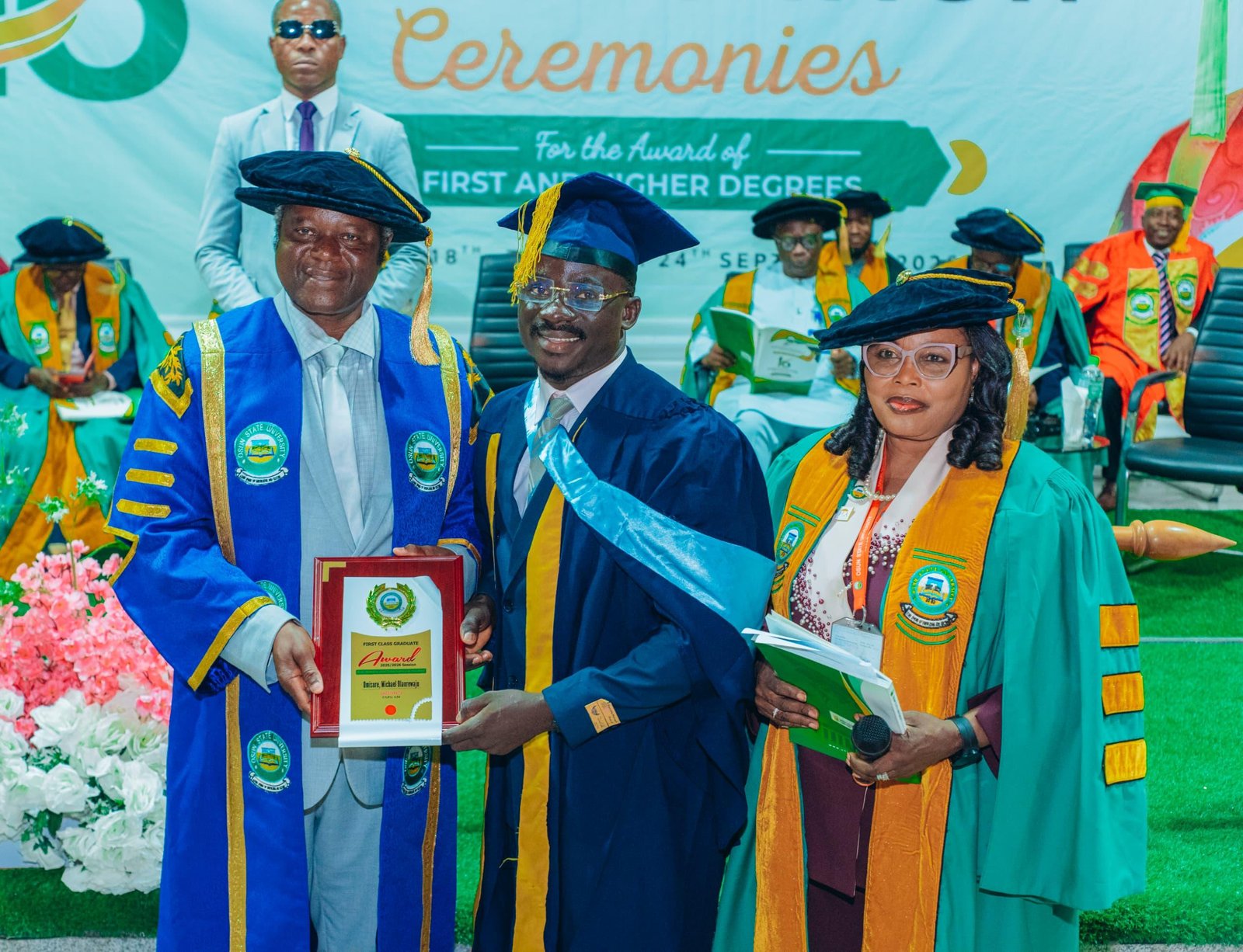
Michael Olanrewaju Omisore, a First-Class graduate of the Department of History and International Studies, Osun State University (UNIOSUN), has reflected on the sacrifices, discipline and personal challenges that shaped his academic journey, graduating with a CGPA of 4.54.
In this interview, Omisore speaks about balancing academics with student leadership, his financial struggles, the role of faith and encouragement in his journey, and the lessons he learnt during his time at the university.
For the record, could you introduce yourself, tell us your department and programme of study, and state your final CGPA?
My name is Michael Olanrewaju Omisore. I am a First-Class graduate of the Department of History and International Studies, Osun State University, with a CGPA of 4.54.
You have graduated with First-Class honours, an achievement that comes with considerable effort and sacrifice. How does this milestone feel, and what does it mean to you?
I think my department had produced First-Class graduates before. If I can remember vividly, I was told that someone graduated from the department with a First-Class degree in 2018.
I did not take this achievement for granted because a lot was sacrificed for it. It means a great deal to me, and I am grateful that I could achieve this milestone.
What study habits, personal values and strategies helped you excel academically while also handling leadership responsibilities and other commitments?
When it comes to time management, I would describe myself as someone who is quite organised and intentional about how I spend my time. I make conscious efforts to plan my daily activities, movements and academic schedule.
As a student, I developed a routine of studying every day, usually early in the morning before lectures and after classes. Of course, there were days when exhaustion, waking up late or other commitments disrupted my plans. Nevertheless, I always made an effort to remain consistent with my studies.
At some point, I had to make certain sacrifices. I reduced my involvement in some social activities and hobbies. For instance, I used to play table tennis, which was one of my favourite hobbies in 100 Level, but I eventually had to put it aside to create more time for academics and other responsibilities.
Things became even more demanding when I got to my third year and was elected Faculty President. Combining academic responsibilities with leadership was not particularly easy. Being a Faculty President required commitment, availability and the ability to attend to students’ welfare.
I had to learn how to balance my academics, political engagements and responsibilities as a student leader while ensuring that my primary objective, which was to study and excel academically, remained a priority.
Beyond academics and leadership, my faith also played a significant role in my journey. I strongly believe in putting God first in everything because, without Him, I am nothing. In my church, I served as a Prayer Coordinator, where I had the responsibility of leading prayer sessions. I genuinely love praying, and my relationship with God has been a major source of strength, direction and encouragement.
Were there moments when you struggled, doubted your ability to succeed or felt overwhelmed by the expectations placed on you? How did you overcome those moments?
Interestingly, I never really saw myself as a scholar. However, people around me gradually began to recognise me as one. Sometimes, someone would simply look at me and say, “You’re a scholar!”
There was even a particular lady who knew about my academic performance and would constantly tell me, “You must graduate with a First-Class degree.” She became one of those people who motivated me to aim higher.
But honestly, those expectations sometimes came with their own pressure. There were moments when I questioned myself and wondered whether I was truly capable of meeting the standards people had set for me. I would ask myself, “Can I really achieve this? Am I good enough? Am I doing enough?”
There were also moments of uncertainty when I questioned whether I was on the right path, especially because I had so many responsibilities and activities competing for my attention. Sometimes, I felt there was so much to accomplish and so little time to achieve everything.
However, through faith, discipline, perseverance and determination, I gradually learned to navigate those challenges. I realised that success is not necessarily about doing everything at once but about understanding your priorities, making sacrifices and remaining committed to your goals.
Looking back, I am grateful for the journey, the people who encouraged me, the responsibilities that shaped me and, above all, God’s grace that kept me going.
We understand that your journey has involved personal and financial challenges. Would you be comfortable sharing some of the difficulties you experienced and how you sustained yourself throughout your university education?
Nothing good comes easily. Before you can become great in life, achieve meaningful things or attain a certain level of wisdom, you must be willing to go through experiences that challenge you, teach you and shape your understanding of life.
I believe experience is one of the greatest teachers. Sometimes, what we call wisdom is simply the knowledge we have acquired from situations we have encountered before.
That is why I believe challenges are an inevitable part of life. They come in different forms and from different directions. There are family challenges, academic challenges, financial challenges and personal struggles. No area of life is completely free from difficulties.
Speaking from my own experience, my journey as a student has not always been easy. My family background was not particularly comfortable financially, but I remain grateful to God for where I am today and for my parents and relatives.
I had to learn how to sustain myself through hard work. I hustled, took up different responsibilities and travelled frequently, sometimes almost every weekend, to work and earn money to supplement my mother’s and uncle’s support for me to attend school.
Those who know me understand that I have never been someone who enjoys sitting around waiting for things to happen. I have always believed in working hard, taking responsibility and finding ways to move forward.
Looking back, those experiences taught me resilience, independence, discipline and financial responsibility. They also helped me understand that opportunities do not always come in the form we expect; sometimes, we have to create them ourselves.
Looking back at your time at UNIOSUN, what are the most important lessons you have learnt, and what advice would you give students striving for academic excellence despite difficult circumstances?
One important lesson I have learnt is that learning never ends. You can never know too much, and you will hardly regret investing in knowledge.
However, I have also realised that studying alone is not enough. You must learn to think critically, work intelligently and develop strategies that help you achieve your objectives.
It is not just about how much you read; it is also about how well you understand, apply and maximise what you have learnt.
You must understand your environment, recognise opportunities and know when to make strategic decisions. Sometimes, the difference between someone who works hard and someone who achieves extraordinary results is the ability to combine hard work with intelligence and the right strategy.
Ultimately, excellence requires more than ambition. It requires discipline, knowledge, critical thinking, consistency and the ability to make the right decisions at the right time.
If you want to stand out in any field, you must be willing to put in the work, develop your intelligence and challenge yourself to think beyond the ordinary.
Because at the end of the day, people recognise excellence, competence and intelligence. And if you desire to be among the best, you must be prepared to think, learn, work and grow beyond your comfort zone.